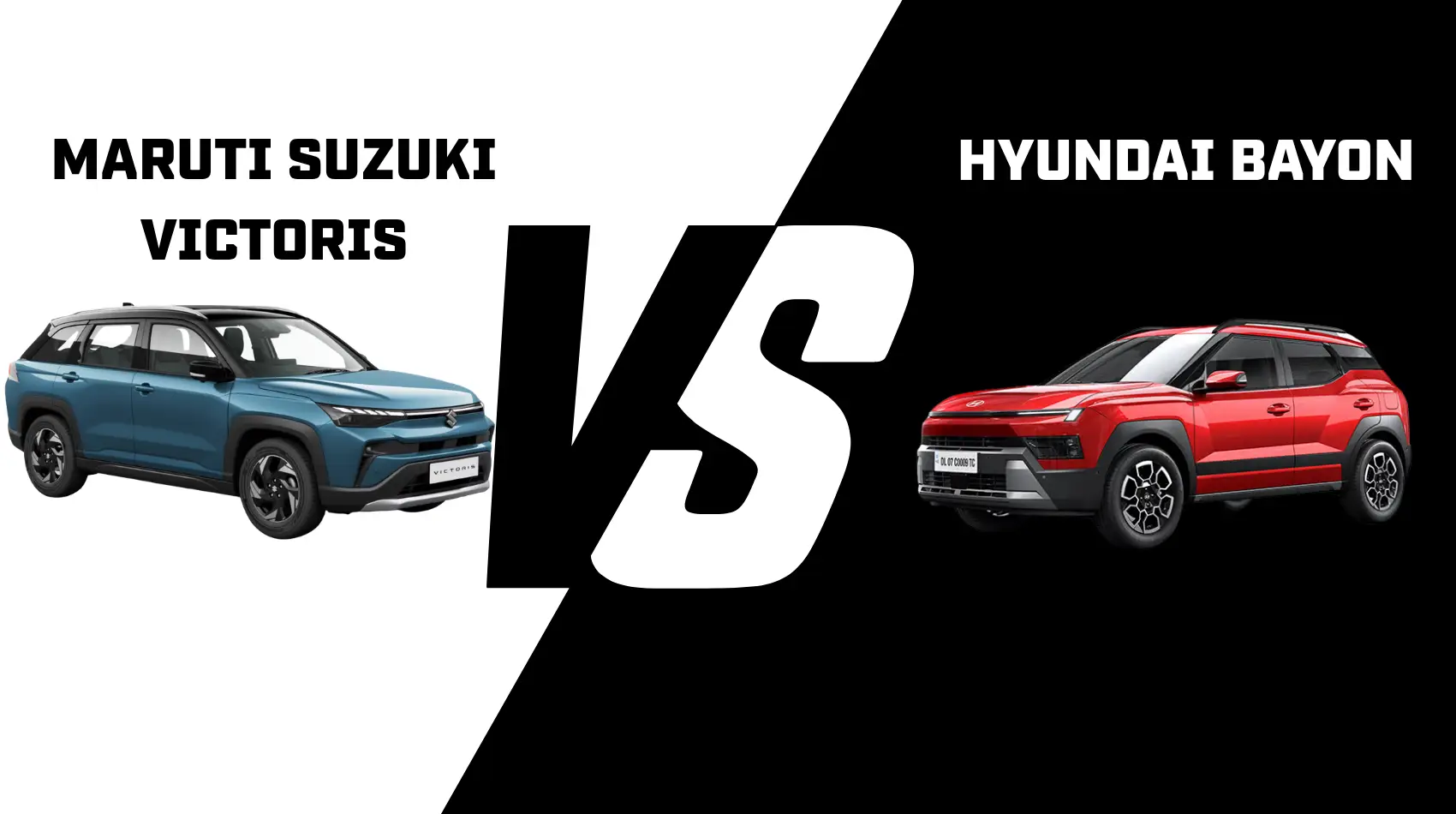
India's SUV segment buyers are always looking for a combination of new segment-first technology, advanced driver assistance systems, multiple powertrain options, comfort, safety, and everyday practicality.
At the centre of this comparison are two mid-size Crossover-SUVs: the Maruti Suzuki Victoris, launched with petrol, strong-hybrid and S-CNG powertrain options, and the Hyundai Bayon, which brings a feature-heavy cabin, a 1.5-litre petrol engine and an extensive safety package.
Both offer a different approach to the modern SUV, particularly in pricing, dimensions, features, performance, and practicality.
Dimensions
|
Parameter
|
Maruti Suzuki Victoris
|
Hyundai Bayon
|
|
Length
|
4,360 mm
|
4,245 mm
|
|
Width
|
1,795 mm
|
1,810 mm
|
|
Height
|
1,655 mm
|
1,605 mm
|
|
Wheelbase
|
2,600 mm
|
2,600 mm
|
|
Ground Clearance
|
210 mm
|
205 mm
|
|
Boot Space
|
439 (Petrol)/320L (CNG-variant)
|
505 litres
|
|
Fuel Tank Capacity
|
45 litres (Petrol) / 55 litres (CNG)
|
43 litres
|
|
Tyre Size
|
215/60 R17
|
205/65 R16 or 215/55 R17, depending on variant
|
Takeaway: The Victoris is 115 mm longer and 50 mm taller than the Bayon, and the Hyundai is 15 mm wider, but both vehicles share an identical 2,600 mm wheelbase.
The Hyundai Bayon offers a boot capacity of 505 litres, making it a practical option for buyers who prioritize luggage space, with the Victoris, on the other hand, introducing a segment-first underbody CNG tank layout, designed to preserve maximum of its 439L foot space even in its S-CNG configuration.
Features Comparison
|
Features
|
Maruti Suzuki Victoris
|
Hyundai Bayon
|
|
Infotainment System
|
10.1-inch SmartPlay Pro X
|
12.3-inch touchscreen
|
|
Instrument Cluster
|
10.25-inch fully digital
|
12.3-inch fully digital
|
|
Apple CarPlay
|
Wireless
|
Wireless
|
|
Android Auto
|
Wireless
|
Wireless
|
|
Connected Car Technology
|
60+ Suzuki Connect features
|
70+ Bluelink features
|
|
Voice Assistant
|
Alexa Auto Voice AI
|
Generative AI Voice Assistant (Powered by Perplexity)
|
|
Audio System
|
8-speaker Infinity by Harman with Dolby Atmos 5.1
|
8-speaker Bose Premium Sound System
|
|
Ambient Lighting
|
64-colour customizable
|
64-colour customizable
|
|
Front Seats
|
Ventilated
|
Ventilated
|
|
Driver Seat
|
8-way powered
|
8-way electrically adjustable
|
|
Panoramic Sunroof
|
Yes
|
Yes
|
|
Wireless Charger
|
Yes, with active cooling fan
|
Yes
|
|
Rear AC Vents
|
Yes
|
Yes
|
|
Rear Seat Adjustment
|
Collapsable with 3-headrests but no reclining seats
|
Two-step rear reclining seats
|
|
Rear Centre Armrest
|
Yes
|
Yes, with cupholders
|
|
Powered Tailgate
|
Gesture-controlled Smart Powered Tailgate
|
Not offered
|
|
Air Quality System
|
PM2.5 filter with AQI display and auto-purify mode
|
Not offered
|
Takeaway:
Both SUVs offer ventilated front seats, an electrically adjustable driver's seat, a panoramic sunroof, and wireless smartphone charging.
The Hyundai Bayon gets a dual curved panoramic display setup with two connected 12.3-inch screens, a perplexity-based AI voice assistant, 70+ connected-car features and a Bose Sound System.
On the other hand, the Maruti Suzuki Victoris gets a 10.1-inch SmartPlay Pro X infotainment system, a 10.25-inch digital instrument cluster, Alexa Auto Voice AI, and an 8-speaker 5.1 surround sound Infinity by Harman audio system.
The Victoris also gets a dedicated gesture-controlled powered tailgate and a PM2.5 air filter with an AQI display that are not present on the Hyundai. The Bayon, meanwhile, offers additional rear-seat comfort features such as two-step reclining seats for additional rear passenger comfort.
Safety Comparison
|
Safety Features
|
Maruti Suzuki Victoris
|
Hyundai Bayon
|
|
Airbags
|
6 (Standard)
|
6 (Standard)
|
|
ABS with EBD
|
Yes
|
Yes
|
|
Electronic Stability Control
|
Yes
|
Yes
|
|
Hill Hold / Hill-start Assist
|
Yes
|
Yes
|
|
Tyre Pressure Monitoring System
|
Yes
|
Yes
|
|
ADAS Features
|
10+ driver-assistance features
|
23 driver-assistance features
|
|
Automatic Emergency Braking
|
Yes
|
Yes
|
|
Adaptive Cruise Control
|
Yes, with Curve Speed Reduction
|
Smart Cruise Control
|
|
Blind Spot Monitoring
|
Blind Spot Monitor with Lane Change Alert
|
Blind-spot View Monitor
|
|
Rear Cross Traffic Alert
|
Yes
|
Yes
|
|
360-degree Camera
|
Yes
|
Yes
|
|
Parking Sensors
|
Yes (Front & Rear)
|
Yes (Front and Rear)
|
|
All-wheel Disc Brakes
|
Yes
|
Yes
|
Takeaway: Both SUVs offer six airbags, electronic stability control, hill-start assistance, and TPMS as standard. However, the Hyundai Bayon offers a more advanced ADAS package with 23 driver-assistance features and three radars.
Power & Efficiency
|
Specification
|
Maruti Suzuki Victoris
|
Hyundai Bayon
|
|
Petrol Engine
|
1.5-litre K15C Dual Jet Dual VVT
|
1.5-litre MPi
|
|
Engine Configuration
|
4-cylinder
|
4-cylinder
|
|
Petrol Displacement
|
1,462 cc
|
1,497 cc
|
|
Petrol Power
|
100.99HP @ 6,000 rpm
|
112.7HP @ 6,300 rpm
|
|
Petrol Torque
|
139Nm @ 4,300 rpm
|
143.8Nm @ 4,500 rpm
|
|
Strong Hybrid
|
1.5-litre Strong Hybrid
|
Not offered
|
|
Manual Transmission
|
5-speed MT
|
6-speed MT
|
|
Automatic Transmission
|
6-speed AT / e-CVT, depending on powertrain
|
7-speed “simulated” CVT/Intelligent Variable Transmission (iVT)
|
|
CNG
|
Factory-fitted S-CNG
|
Not offered yet
|
|
Four-wheel Drive
|
ALLGRIP Select 4x4
|
Not offered
|
|
Strong Hybrid Efficiency
|
28.65 km/l
|
Not offered
|
|
CNG Efficiency
|
27.02 km/kg
|
Not offered yet
|
Highlight:
Maruti Suzuki Victoris: The Victoris offers three different powertrain options – a 1.5-litre K15C petrol engine with Smart Hybrid technology, a 1.5-litre Strong Hybrid (paired with an e-CVT transmission) and a factory-fitted S-CNG setup.
Victoris also gets the ALLGRIP Select 4x4 system, paired with a 6-speed automatic transmission, paddle shifters and 4 terrain modes, along with Hill Descent Control.
Hyundai Bayon: The Bayon uses a more powerful conventional petrol engine, four-cylinder 1.5-litre MPi petrol engine (shared with the Creta, Seltos, and Verna), available with a 6-speed manual transmission and an CVT/Intelligent Variable Transmission (iVT).
Price Comparison
|
SUV
|
Starting Price (Ex-showroom)
|
|
Maruti Suzuki Victoris
|
₹10.49 lakh
|
|
Hyundai Bayon
|
₹9.99 lakh
|
Takeaway: The Hyundai Bayon has a lower starting price of ₹9.99 lakh, with the Maruti Suzuki Victoris starting at ₹10.49 lakh (₹50,000 undercutting), with the difference coming down to the powertrain and features buyers are looking for.
Final Verdict: Which SUV is Right for You?
Ultimately, choosing between the Maruti Suzuki Victoris and Hyundai Bayon comes down to what buyers value over the long term. The Victoris makes a stronger case for those seeking versatility and a wider choice of engine options, while the Bayon appeals to those who prioritize everyday comfort, practicality, more premium cabin experience, and a well-established petrol powertrain.