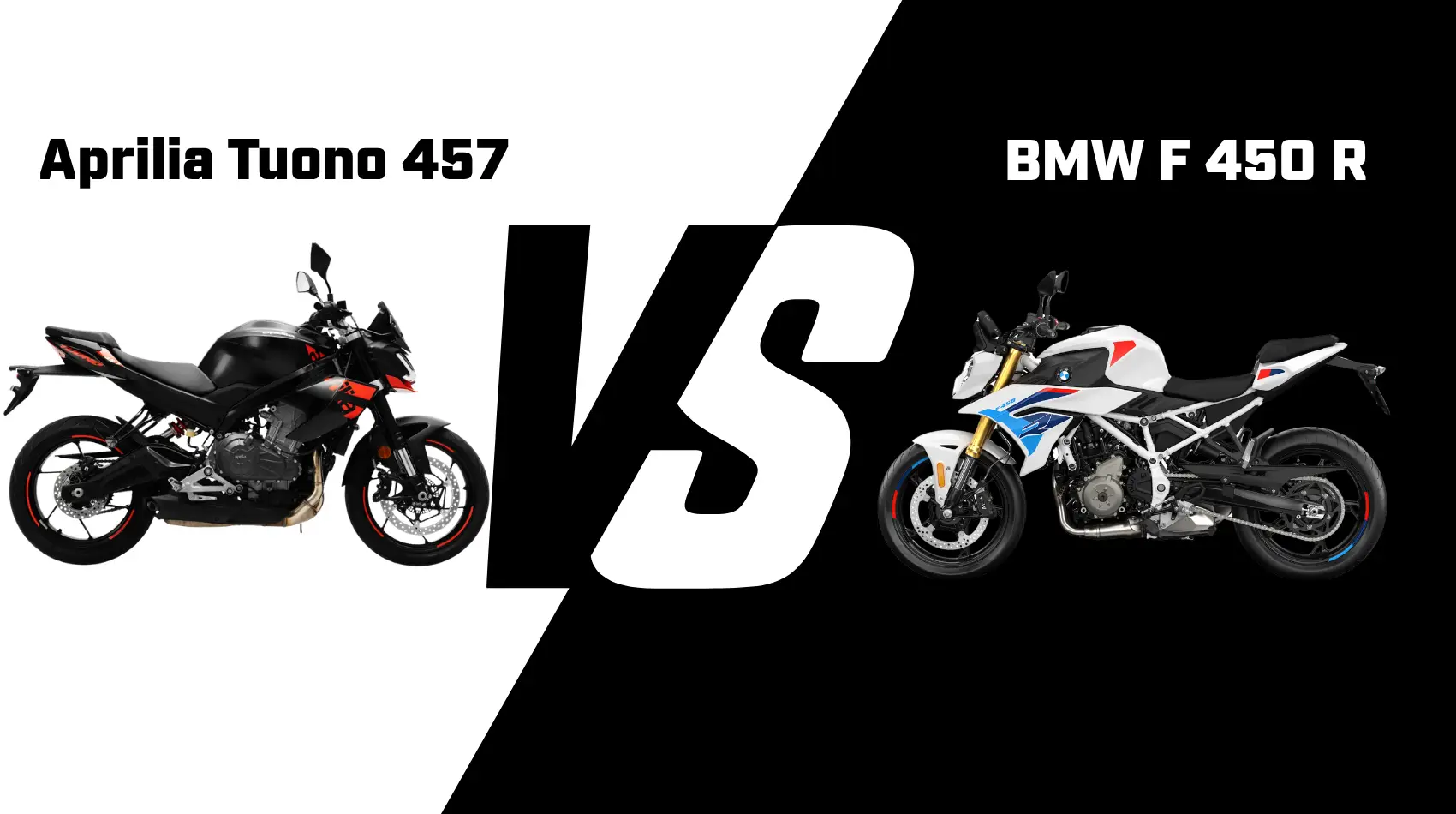
The middleweight naked-bike segment is getting increasingly interesting, and the arrival of the BMW F 450 R gives the Aprilia Tuono 457 some serious competition. On paper, both motorcycles follow a very similar formula: parallel-twin engines, roughly 48 hp, 17-inch wheels, sporty styling and a strong focus on accessible performance. But dig a little deeper and it becomes clear that BMW and Aprilia have taken rather different approaches to achieving the same goal.
The BMW F 450 R has been developed as a compact roadster with a clear emphasis on agility, electronics and everyday usability. It also borrows heavily from BMW Motorrad's larger S 1000 R in terms of styling and philosophy. The Aprilia Tuono 457, meanwhile, has always had a more aggressive, performance-oriented character, with its aluminium chassis, compact dimensions and sporty riding position. Aprilia itself positions the Tuono 457 as a naked bike built around daily riding and fun, while highlighting its power-to-weight ratio and handling as key strengths.
So, which one makes more sense? On paper, the two look remarkably close. In reality, they could appeal to very different kinds of riders.
Engine and Performance
This is perhaps the closest contest between the two motorcycles.
The BMW F 450 R is powered by a 420cc, liquid-cooled parallel-twin engine which produces 48hp at 8750rpm and 43 Nm of torque at 6750rpm. BMW has given the engine a 135-degree crankpin offset and a balance shaft, with the intention of giving it a distinctive character while keeping vibration under control. More importantly, BMW says 80 per cent of the available torque is accessible from 3000rpm, suggesting that the F 450 R should have plenty of usable response without requiring the rider to constantly chase the rev limiter.
The Aprilia Tuono 457 is powered by a slightly larger 457cc parallel-twin. It produces 47.6hp at 9400rpm and 43.5 Nm of torque at 6700rpm. The Aprilia Tuono 457 uses a 270-degree crank configuration, giving its parallel-twin a more distinctive character and a firing order. The peak figures are almost identical to the BMW. The Aprilia uses a six-speed gearbox and a wet multi-plate clutch with a slipper system.
On pure numbers, there is very little separating them. The Aprilia has the displacement advantage and a tiny edge in torque, while the BMW produces fractionally more peak power. But the character of the two engines could be more important than the numbers. BMW appears to have concentrated on accessible low- and mid-range performance, while Aprilia's engine has a slightly higher-revving peak-power character.
Chassis, Suspension and Brakes
This is where the two motorcycles begin to show their different engineering philosophies.
The BMW F 450 R uses a tubular steel space frame with the engine acting as a load-bearing element. It gets a 43mm KYB upside-down fork, while the rear uses an aluminium swingarm and KYB central spring strut. The standard rear setup gets adjustable spring preload and rebound damping, while BMW's optional Sport Suspension adds compression and rebound adjustment to the front fork.
The Aprilia takes a different route. Its Tuono 457 uses a twin-spar aluminium frame, with a 41mm USD front fork offering preload adjustment and 120mm of travel. At the rear is a preload-adjustable monoshock with 130mm of travel.
The difference is interesting. BMW has opted for a steel space-frame architecture related to its F 450 GS platform, whereas Aprilia has gone with an aluminium twin-spar frame. That doesn't automatically make one better than the other, but it does underline the personalities of these bikes. The Aprilia feels like the more traditionally sporty machine on paper, while the BMW appears to have been engineered around a broader mix of agility, accessibility and everyday road riding.
Braking hardware is similarly well matched. The BMW gets a 310mm front disc with a Brembo four-piston monobloc caliper and a 240mm rear disc with a ByBre single-piston caliper. BMW Motorrad ABS Pro is standard.
The Tuono 457 uses a larger 320mm floating front disc with a ByBre four-piston radial caliper and a 220mm rear disc. It also gets dual-channel ABS with an anti-roll-over system.
On paper, the Aprilia's larger front disc and radial caliper sound impressive, but BMW's Brembo hardware and lean-sensitive ABS Pro give it a strong technological advantage. Ultimately, both appear more than adequately equipped for the performance these motorcycles offer.
Weight and Dimensions
Weight is another area where this comparison gets interesting because both motorcycles claim a kerb/road-ready weight of 175kg.
The BMW F 450 R has a road-ready weight of 175kg, a 790mm standard seat height, a 14-litre fuel tank, a 1,405mm wheelbase and overall dimensions of 2,002mm in length and 825mm across the handlebars.
The Aprilia Tuono 457 also weighs 175kg, but uses a slightly smaller 13-litre fuel tank and has a taller 810mm seat height.
That 20mm difference in seat height could actually matter more than it looks on paper. The BMW's 790mm standard seat should make it the easier motorcycle for a wider range of riders to get comfortable with, particularly in traffic or when manoeuvring at low speeds. BMW also offers optional 775mm and 810mm seat heights, giving it considerable flexibility.
The Aprilia's 810mm seat, meanwhile, should give taller riders a more natural riding position, although shorter riders may find the BMW more approachable.
Interestingly, both motorcycles achieve the same 175kg figure despite using very different chassis concepts. That makes the BMW's weight optimisation particularly notable, while the Aprilia's aluminium frame remains one of its defining engineering features.
Features and Rider Aids
This is arguably where BMW pulls away from the Aprilia, at least on paper.
The F 450 R comes standard with Rain, Road and Dynamic riding modes, along with Dynamic Traction Control, Dynamic Brake Control, Engine Drag Torque Control and ABS Pro. It also gets a 6.5-inch TFT display with connectivity for calls, music and navigation, along with a USB-C port. Heated grips and LED lighting are also standard.
The higher-spec versions take things further with Riding Modes Pro, including a configurable Dynamic Pro mode. The M Sport variants also receive additional Sport displays that can show traction-control intervention, braking force and lean angle, along with a lap timer.
There is also a rather unusual feature in the form of BMW's optional Easy Ride Clutch. When combined with Shift Assistant Pro, it can allow the rider to move off, stop and change gears without manually operating the clutch lever. That could be particularly useful in heavy urban traffic.
The Aprilia Tuono 457 is hardly basic, though. It gets ride-by-wire, three riding modes — Eco, Sport and Rain — and adjustable Aprilia Traction Control that can be set across three levels or switched off. The motorcycle also gets a 5-inch full-colour TFT display and backlit handlebar controls.
The Aprilia's standard equipment also includes dual-channel ABS with an anti-roll-over system, full LED lighting, engine maps and metal-braided brake hoses.
The Tuono can also be upgraded with an optional up/down quickshifter, TPMS, electronic anti-theft system, USB socket and other accessories.
If you're looking strictly at the equipment list, BMW seems to have the more comprehensive electronics package, especially in the higher variants. The Aprilia, however, arguably gives you everything you really need to enjoy the motorcycle without making the experience feel overly complicated.
Pricing and Verdict
Pricing could ultimately be the deciding factor in this comparison. The Aprilia Tuono 457 already has an established price in India, while BMW is yet to announce how much the F 450 R will cost when it eventually arrives here. Aprilia Tuono 457 is priced at ₹3.99 lakh (ex-showroom). If BMW manages to position the F 450 R competitively, it could become a very compelling alternative to the Aprilia, particularly for riders who value its larger TFT, broader electronics package, lower standard seat height and BMW badge. But if the BMW carries a significant premium, the Aprilia Tuono 457 could remain the more attractive proposition for someone who simply wants an engaging, sporty middleweight naked bike. On paper, the Aprilia looks like the purist's choice, while the BMW seems to be the more rounded and technology-heavy motorcycle. The real winner, therefore, may come down less to outright performance and more to how much you are willing to pay for the BMW's additional equipment and refinement.