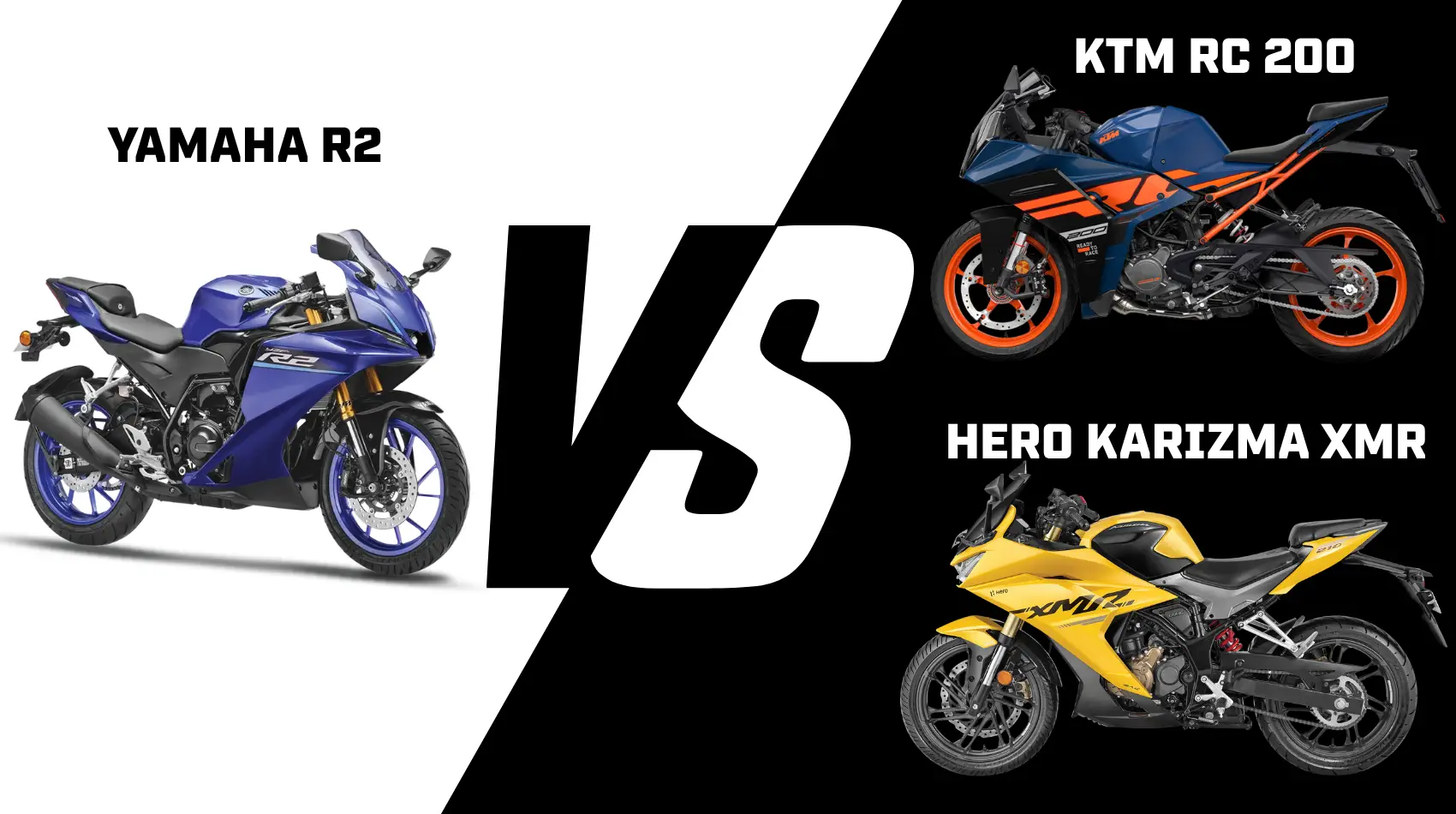
The 200cc sportbike segment in India has some serious history behind it. The KTM RC 200 has been a part of this segment for more than a decade, establishing itself as one of the sharpest and most performance-focused motorcycles in the class. Then there is the Hero Karizma, a name that holds a legendary place in Indian motorcycling history. The current Karizma XMR carries that legacy forward with a modern 210cc engine and a contemporary take on the iconic name. Now, Yamaha has entered the 200cc segment with the R2, bringing the R-series DNA that already has a strong following in India, thanks largely to the long-running R15, which has been one of the country’s most popular entry-level sportbikes for years. The R2 takes that familiar R-series formula and brings it into a segment where it now has to compete with some well-established names.
So, can Yamaha’s newest R-series motorcycle shake up the 200cc sportbike segment, or do the KTM RC 200 and Hero Karizma XMR still have enough going for them to hold their ground?
Engine and Performance
The Yamaha R2 is powered by a 204cc, single-cylinder, liquid-cooled engine which produces 26.5hp at 10000rpm and 19.1Nm of torque at 8000rpm. This engine is paired with a 6-speed gearbox, with a slip-and-assist clutch offered as standard. A quickshifter is available from the mid-spec variant.
The KTM RC 200, meanwhile, gets a 199.5cc, single-cylinder, liquid-cooled engine producing 25hp at 10000rpm and 19.2Nm at 8000rpm, paired with a 6-speed gearbox.
The Hero Karizma XMR gets a slightly larger 210cc, single-cylinder, liquid-cooled engine producing 25hp at 9250rpm and 20.4Nm at 7250rpm, also paired with a 6-speed gearbox.
On paper, the Yamaha has a small advantage in peak power, while the Karizma XMR produces the most torque of the three. The KTM sits between the two in terms of power and torque figures. The R2’s higher peak power could give it an advantage when the engine is being pushed towards its redline, while the Karizma’s stronger torque figure and lower torque peak could make it feel more accessible during everyday riding. The RC 200’s character has already been familiar to riders for years. For everyday riding, the difference between these three motorcycles is unlikely to be dramatic, but each one has its own approach to performance.
Chassis and Suspension
The Yamaha R2 uses a steel tube diamond frame with a 37mm upside-down fork at the front and a monoshock suspension at the rear.
The KTM RC 200 gets KTM’s split trellis frame, along with larger 43mm upside-down front forks and a 10-step adjustable rear monoshock.
The Hero Karizma XMR gets a steel trellis frame, and now gets 37mm upside-down forks at the front and a 6-step adjustable gas-charged monoshock at the rear.
On specifications alone, the KTM looks more focused on adjustability and hardware. Its 43mm front forks and adjustable rear suspension give riders more scope to tune the motorcycle according to their riding style and conditions. The Karizma offers a six-step adjustable rear monoshock at this price point that adds good value. For someone who enjoys experimenting with suspension settings, the RC 200 and Karizma XMR have the clear advantage. For a rider who simply wants a sporty motorcycle that works well straight out of the showroom, the R2 could prove to be the easier choice.
Brakes and Tyres
The KTM RC 200 gets larger brakes, with a 320mm front disc and 230mm rear disc, while the Yamaha R2 uses a 282mm front disc and 220mm rear disc. The Karizma XMR gets a 320mm petal disc at the front and a 230mm petal disc at the rear. All of these motorcycles get dual-channel ABS. All of these motorcycles also get 17-inch front and rear rims. The KTM gets wider tyres, a 110-section front and 150-section rear tyre. The Yamaha uses a 100-section front and 140-section rear tyre. Interestingly, the Karizma uses the same 100-section front and 140-section rear tyre size as the Yamaha R2. Again, the RC 200 appears to have the more aggressive hardware on paper. The larger brakes and wider tyres should appeal to riders who plan to ride hard and want a motorcycle with a more substantial feel under braking and cornering. The Yamaha’s and Hero’s narrower tyres could, however, contribute to a lighter and more agile feel. And that brings us to one of the biggest differences between these three motorcycles.
Weight and Dimensions
The Yamaha R2 weighs 149kg kerb, which is 11kg lighter than the KTM RC 200’s 160kg kerb, and 14.5kg lighter than the Karizma XMR, which weighs 163.5kg kerb. That is a significant difference for a motorcycle in this segment. The Yamaha R2 and Karizma XMR both get a lower 810mm seat height compared with the RC 200’s 835mm seat height. This could make the Yamaha R2 and Karizma XMR more approachable for a wider range of riders, particularly those who aren’t completely comfortable with taller motorcycles.
The KTM gets a larger 13.7-litre fuel tank, compared with the R2’s 12-litre fuel tank and Karizma’s 11-litre fuel tank. For city riding and quick direction changes, the Yamaha’s lower weight could be one of its biggest strengths. The RC 200 and Karizma XMR, on the other hand, have the dimensions and hardware that give them a more substantial sports-bike feel.
Features
All three motorcycles bring smartphone connectivity; the Yamaha R2 gets a 5-inch TFT instrument cluster with Yamaha Y-Connect connectivity, which offers call and SMS alerts and turn-by-turn navigation. It also gets three riding modes: Street, Sport and Rain, and traction control. The KTM RC 200 also gets a 5-inch TFT display with similar features as the Yamaha R2 but misses out on riding modes. It gets traction control, a Supermoto ABS mode and a quickshifter as standard. The Hero Karizma XMR gets a smaller 4.2-inch TFT display with smartphone connectivity, call and SMS alerts and turn-by-turn navigation. It doesn’t get traction control, but it does get three ABS modes: Road, Pro and Rally.
This is an interesting area because all three motorcycles take different approaches. The Yamaha focuses more on electronic riding modes and everyday usability, with a dedicated Rain mode adding an extra layer of flexibility. KTM, meanwhile, gives the RC 200 a quickshifter as standard, which is a feature that should appeal strongly to riders who enjoy spirited riding. The Karizma takes a slightly different route with its ABS modes: Road, Pro and Rally. If outright sporty riding is the priority, the KTM’s quickshifter is a significant advantage. If versatility and day-to-day usability matter more, the Yamaha’s riding modes make a strong case for the R2. The Karizma, meanwhile, offers useful electronic features while keeping its price considerably lower.
Pricing
The KTM RC 200 is priced at ₹2,31,678 (ex-showroom), while the Yamaha R2 is priced at ₹2,39,500 (ex-showroom) for the standard variant and ₹2,53,000 (ex-showroom) for the top variant. The Hero Karizma XMR is significantly cheaper at ₹1,86,644 (ex-showroom).
This puts the Karizma more than ₹45,000 below the RC 200 and more than ₹50,000 below the standard R2.
The RC 200 still offers a strong value proposition considering the equipment it gets, including the larger brakes, adjustable rear suspension and standard quickshifter. Yamaha is clearly asking buyers to pay a premium for the newer product and its R-series package. The Karizma, however, makes a different argument altogether. It gives buyers a 210cc engine, 320mm front brake, adjustable rear suspension, TFT display and multiple ABS modes for considerably less money. If budget is an important part of the decision, it is difficult to ignore what Hero is offering here.
Verdict
On paper, the Yamaha R2 looks like a very strong new entrant. It is lighter, makes slightly more power, has a lower seat height and brings three riding modes along with Yamaha’s Y-Connect system. But the KTM RC 200 still has some serious advantages. It gets larger brakes, wider tyres, adjustable rear suspension and a quickshifter as standard. More importantly, it has more than a decade of experience in this category. The Karizma XMR adds another layer to the comparison. It makes slightly less power than the R2 but produces more torque, gets the same 320mm front and 230mm rear brake sizes as the KTM, offers an adjustable rear monoshock and has an 810mm seat height. Most importantly, it costs considerably less than both the KTM and Yamaha. The Yamaha R2 doesn’t necessarily make the RC 200 outdated. Instead, it gives buyers another kind of 200cc sportbike. And the Karizma makes the decision even more complicated by offering a lot of motorcycles for the money. If you want the lightest motorcycle with a more approachable seat height, modern riding modes and Yamaha’s R-series appeal, the R2 looks like the more interesting new-age option. If outright sporty hardware, aggressive riding equipment and a proven track record are higher on your list, the RC 200 still makes a very strong case for itself. And if value for money is your biggest priority, the Karizma XMR is difficult to overlook.