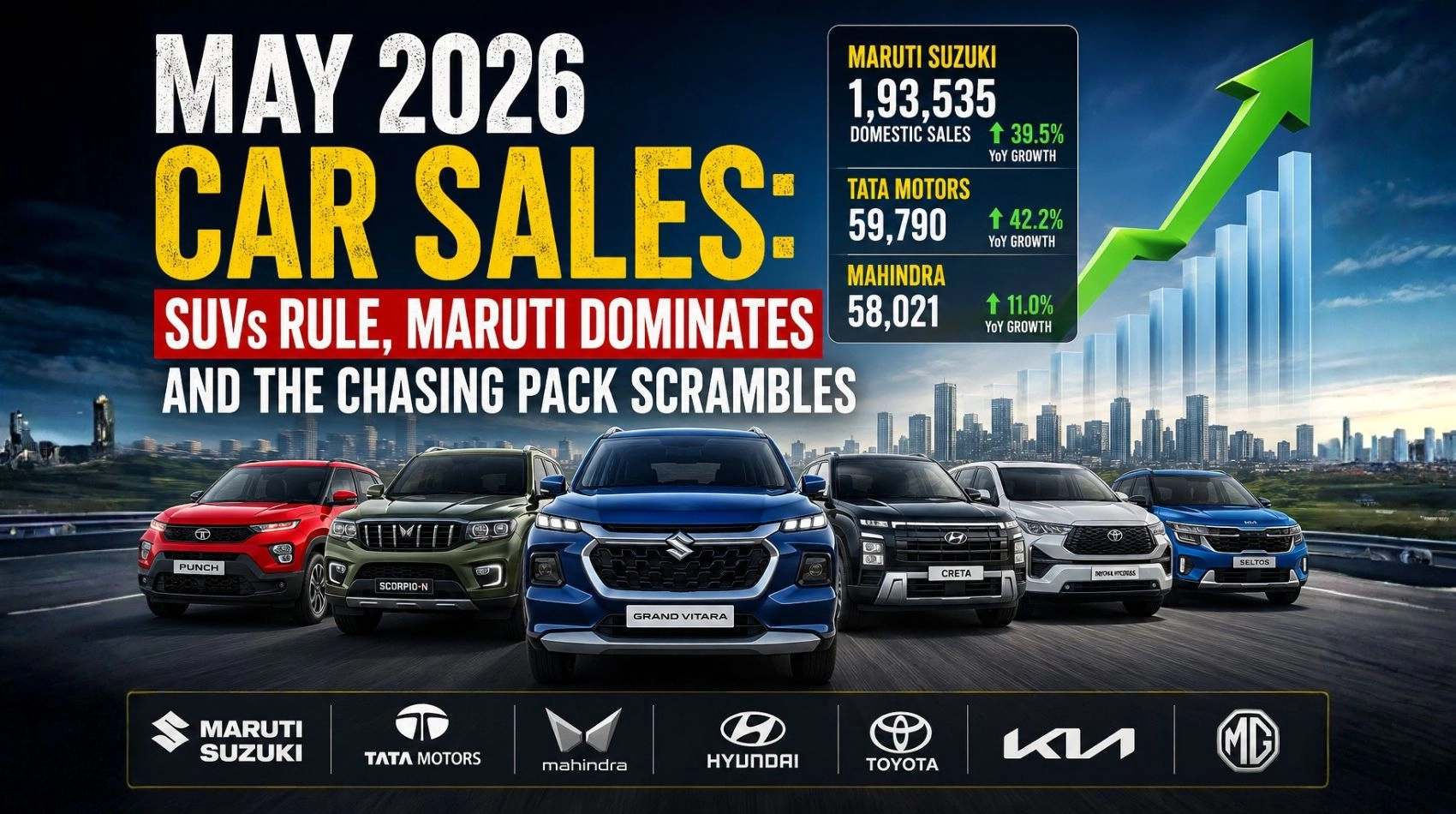
The Indian passenger vehicle market continued its strong run in May 2026, and while there were plenty of interesting stories unfolding beneath the surface, one thing remains abundantly clear — Maruti Suzuki is operating in a league of its own. Behind it, however, the battle for second place is becoming increasingly intense, with Tata Motors, Mahindra and Hyundai all fighting for position as SUVs continue to drive growth across the industry.
SUVs continue to dominate buyer preferences, hybrids are steadily gaining traction, EV adoption is increasing, and manufacturers are working harder than ever to capture market share. But the biggest story of the month remains Maruti's ever-growing lead at the top.
Maruti Suzuki Continues To Rewrite The Rulebook
Maruti Suzuki recorded its highest-ever monthly sales performance in May 2026, selling 2,42,688 units overall. Domestic passenger vehicle sales stood at 1,93,535 units, while exports contributed another 41,914 units.
That's a healthy 39.5 per cent increase over the 1,38,690 units it sold in May 2025 and highlights just how strong demand remains across Maruti's portfolio. The Fronx, Brezza, Grand Vitara and Ertiga continue to post strong numbers, while the Dzire remains one of the country's best-selling passenger vehicles.
At this point, Maruti isn't simply leading the market anymore — it's widening the gap to everyone else.
Tata Motors Remains Right In The Fight
Tata Motors Passenger Vehicles Ltd. registered total sales of 59,790 units in May 2026, compared to 42,040 units in May 2025, representing a healthy 42.2 per cent year-on-year growth.
The Punch continues to be one of the country's biggest volume drivers, while the Nexon, Curvv, Harrier and Safari collectively ensure Tata remains a major force in the SUV segment. The company also continues to lead India's EV market, with models such as the Punch EV, Nexon EV and Curvv EV helping strengthen its position further.
More importantly, these numbers keep Tata firmly in the battle for second place. While Mahindra currently enjoys immense momentum thanks to its SUV-led portfolio, Tata's broad product range and strong EV presence ensure it remains one of the most important players in the Indian passenger vehicle market.
Mahindra's SUV Charge Shows No Signs Of Slowing
Mahindra once again posted a stellar performance, recording domestic SUV sales of 58,021 units in May 2026.
That represents an 11 per cent year-on-year increase over the 52,431 units sold in May 2025 and further cements Mahindra's position as India's SUV specialist. The Scorpio-N, Thar Roxx, XUV 7XO and the company's expanding electric vehicle portfolio continue to attract strong demand.
What's perhaps most impressive is that Mahindra has now consistently managed to stay ahead of Hyundai in monthly domestic passenger vehicle sales — something that would've seemed unlikely just a few years ago.
Hyundai Holds Firm, But The Pressure Is Growing
Hyundai reported domestic sales of 47,837 units during May 2026, while total sales including exports stood at 61,137 units.
That's a healthy 9.1 per cent increase over the 43,861 units sold during the same period last year. The Creta remains the backbone of Hyundai's success story, supported by the Venue, Exter and Alcazar.
However, Hyundai finds itself in a far more competitive environment than before. Mahindra's SUV-led surge and Tata's continued strength mean the Korean manufacturer is having to work harder than ever to maintain its place near the top of the sales charts.
Toyota's Quiet Success Story Continues
Toyota Kirloskar Motor reported domestic sales of 30,574 units in May 2026, with total sales including exports reaching 33,128 units.
Compared to the 29,280 units it sold in May 2025, that's a growth of around 4.4 per cent. The Innova Hycross remains one of the company's biggest success stories, while the Urban Cruiser Hyryder continues to benefit from growing demand for hybrid technology. The Fortuner, meanwhile, remains the benchmark in the premium SUV segment.
Toyota's strategy of focusing on strong hybrids appears to be paying off as more buyers look for fuel-efficient alternatives without making the jump to a fully electric vehicle.
Kia Records Its Best-Ever May Sales Performance
Kia India registered wholesale sales of 27,586 units in May 2026, its highest-ever May sales performance since entering the Indian market. Compared to 22,315 units sold in May 2025, the company posted a healthy 23.6 per cent year-on-year growth.
The strong performance has been driven by sustained demand across the Sonet, Seltos and Carens range. More recently, the launch of the Carens Clavis and the all-electric Clavis EV has further strengthened Kia's position in the family car and EV segments.
Kia's momentum isn't limited to just one month either. The company has recorded 1,39,197 units in year-to-date sales during 2026, compared to 1,21,514 units during the same period last year, reflecting a 14.6 per cent growth. That consistency continues to make Kia one of the strongest performers in the Indian market despite competing against much larger and more established rivals.
Honda Cars India: Small Volumes, Big Growth
Honda Cars India recorded total sales of 7,853 units in May 2026, comprising 5,111 domestic units and 2,742 exports. That translates to a healthy 31 per cent year-on-year growth, making Honda one of the fastest-growing passenger vehicle manufacturers in the country during the month.
The growth comes at an important time for the brand. Honda recently introduced the facelifted City sedan, while the newly launched ZR-V has further strengthened its premium portfolio. The Amaze and Elevate also continue to contribute strongly to overall volumes.
While Honda's overall sales numbers remain significantly lower than rivals such as Maruti Suzuki, Hyundai, Mahindra, Tata Motors and Kia, the strong year-on-year growth suggests the brand's renewed product push is beginning to gain traction. The City facelift, in particular, appears to have given the sedan a timely boost, while the Elevate continues to anchor Honda's SUV ambitions in India.
MG Maintains Steady Momentum
JSW MG Motor India reported sales of 6,048 units in May 2026.
While that figure is marginally lower than the same period last year, MG continues to benefit from strong demand for the Windsor EV, which has quickly become one of the most important products in its portfolio. The Comet EV, Hector and Astor also continue to contribute steady volumes as the brand strengthens its position in India's growing EV market.
SUVs Continue To Drive The Market
If there's one trend that continues to define the Indian automotive landscape, it's the relentless rise of SUVs.
From Maruti and Mahindra to Tata, Hyundai, Toyota and Kia, almost every major manufacturer is seeing its strongest growth come from utility vehicles. Buyers continue to prioritise practicality, higher seating positions and road presence, forcing manufacturers to double down on SUVs across virtually every price segment.
Interestingly, however, sedans aren't entirely out of the picture. Industry data suggests the segment has shown signs of recovery in recent months, helped significantly by the continued success of the Maruti Suzuki Dzire.
EVs And Hybrids Continue To Gain Ground
Electrification is steadily gathering momentum.
Passenger EV volumes crossed 2.2 lakh units during FY2026, with Tata, MG and Mahindra leading the charge. At the same time, hybrid vehicles are becoming increasingly popular among buyers looking for better fuel efficiency without the dependency on charging infrastructure.
Toyota and Maruti, in particular, continue to benefit from this growing acceptance of hybrid technology.
The Bigger Picture
May 2026 reinforced many of the trends we've been seeing for the past few months. SUVs continue to dominate buying preferences, EV adoption is gradually increasing, hybrids are finding more acceptance and competition beneath Maruti Suzuki is fiercer than ever. Honda was another noteworthy performer in May 2026. While its overall volumes remain relatively modest, the company recorded over 31 per cent year-on-year growth, aided by the launch of the new City facelift, the arrival of the ZR-V and sustained demand for the Amaze and Elevate.
But above all else, the month belonged to Maruti. With record-breaking sales, booming exports and unmatched scale, it has widened the gap to the rest of the market once again.
Meanwhile, the real battle is unfolding behind it. Tata Motors has edged into second place, Mahindra's SUV offensive remains relentless, Hyundai is fighting to hold its ground, while Toyota and Kia continue to post steady gains. If May's numbers are anything to go by, the race for position behind Maruti could be one of the defining stories of FY27.

.webp)